

Self-Esteem vs Self-Punishment
How your self-concept fuels the way you treat yourself.
I’m Gab, a personal stylist on a mission to help women feel hot again – no matter their size. If that sounds like a relief, book a free call here. I have 2 spots left for The Next Edition for this summer.
I tend to get thinner when it’s cold and thicker when it’s warm.
In the winter I’m less social, I eat at home and work out more, drink less. In the summer I travel, go out, drink and eat more and go to the gym less.
Separately, I am very sensitive to heat, so I don’t wear pants between May and September.
The confluence of these two things created a painful cycle for most of my 20s.
Every September, when I put jeans back on for the first time, they would be SO TIGHT.
Did I learn my lesson and buy a bigger size? No.
Did I wear them anyway even when I had waistband-shaped bruises around my torso and on my hipbones for weeks? Yes.
Within a month or two, I’d get a little slimmer and it would be fine. I would feel relieved that the pain was gone, both emotional (the shame of being bigger) and the physical (bruises).
Looking back now, I realize that the idea of getting bigger pants never even occurred to me. I was a size 6. That was part of my identity. I would be a different (and worse) person if I bought size 8 jeans.
I told myself I could get through it and it wasn’t that bad.
I told myself this was just the cycle of my body and the few weeks of bruising was an expected part of my life.
I told myself that I deserved the pain for getting bigger. It makes me sad to write that now, but it was how I felt at the time.
Clearly, this was coming from a place of self-punishment. A place I had lived in for most of my life as it related to my relationship with my body.
If you’ve been here for a while, you know that I grew up as a fashion-obsessed ballet dancer in a chubby body, so I have been on a journey with my body acceptance. If you’re new, hi!, and now you know.
With my mind, however, it was a totally different story. I was a strong student, mostly got A’s and like a good eldest daughter, was “a pleasure to have in class.” When I got a lower grade or messed up an assignment, I forgave myself and did not tie those incidents to my sense of my intelligence or academic ability. My self-concept was that I was smart and good at school. Even in the few classes where I had a harder time, those difficulties did not change what I knew to be true about myself. I am smart! I know how to get good grades and glowing report cards! (With the occasional note about talking too much in class 🤷🏻♀️)
I remember a kid making fun of me for being the last one to learn how to write my full name. Without skipping a beat I said back that I had by far the longest name in the class (23 letters!) and it wasn’t because I was stupid.
It makes me smile now to think of little me being this self-assured.

What can you take away from this?
The difference between how I felt about my body and how I felt about my mind is not about the body or mind themselves.
The difference is resilience.
The difference is also about my self talk, which was coming from a place of acceptance for my mind and rejection for my body.
When I gained weight, even in an expected and predictable way, I told myself I was weak and a failure. I deserved to be in physical pain as penance for not remaining a size 6 after a summer of enjoying myself.
When I messed up on a test, it didn’t alter my understanding of myself as a good student. I just accepted that I didn’t do my best that time.
How I felt about my body was rooted in self-punishment.
How I felt about my mind was rooted in self-esteem.
When your self-concept is shaky, you let your actions and results serve as evidence that you had it wrong all along. You will happily believe any shred of evidence that says you are worse than you thought. This is self-punishment.
When your self-concept is clear, you define actions and results that don’t match it as anomalies. This is self-esteem.
The other piece of self-esteem is belief in your own value. The belief that you are just as important as anyone else, that your wants and needs matter and that you can assert them.
As women, we’ve been taught to always put others first, and this is something that many of us need to deprogram. Of course, there are times when we need (and want!) to put others first, but having that be the default is not a way to build self-esteem.
I’ve been cultivating my self-esteem by choosing to prioritize my comfort and desires over the comfort and desires of others AND over my fear of the perception and judgement of others.* By doing this, I am repeatedly showing myself that what I want is valuable. With enough reps, my decision-making has shifted from “what will they think?” to “what do I want?”
*Of course there are times when I put a loved one’s needs and wants over mine, that’s part of having relationships. But some random guy on the subway blocking the entire pole with his sweaty torso? I will be asking him to move and I know that will make him uncomfortable.
Self-esteem vs self-punishment as it relates to your style
How you feel about your body affects what you want to put on it, whether you are conscious of it or not. You can use clothes to hide and change what you don’t like about your body, you can use them to show it off and you can use them to do neither, and blend in.
Self-Punishment
If you know me, you know I hate the word flattering.
TL;DR As millennials, our boomer moms trained us that everything should be flattering, which was code for making you look as thin as possible.
People who don’t like the shape of their bodies seek out things that make them look different. Oftentimes the goal is to be thinner but I’ve also had clients who wanted to look shorter because they were “too tall” or make their feet smaller because they were “too big” or make their shoulders narrower because they were “too wide.” This is all coming from a place of self-punishment – their bodies are wrong and need to be corrected.
A friendly reminder that skinny is not a style. Choosing thinness as the goal eliminates the opportunity for creativity, play and fun. Style should not be a place to shame ourselves.
The other way this can manifest is by wearing clothes that no longer fit you because you’re disappointed that you’ve changed. Whether it’s weight gain or loss, I see clothes that don’t fit in every closet I look at. Whether you’re squeezing yourself into too small clothes like I did, or drowning in too big clothes, you’re punishing yourself for changing. This is usually rooted in shame. You feel that you’re a bad person because your body hasn’t stayed the same and the new version is worse.
Self-Esteem
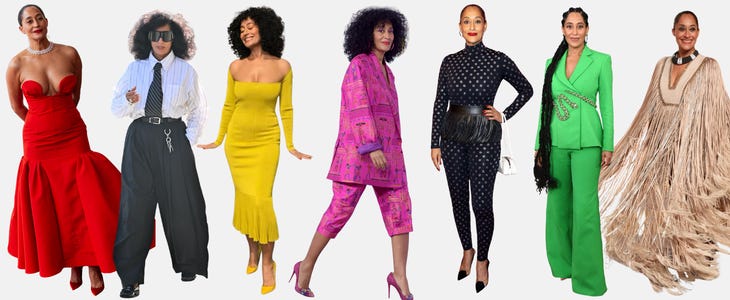
Dressing from a place of self-esteem is not necessarily about wearing revealing or tight clothing, though it can be. For some people, self-esteem dressing can be wearing bright colors, loud prints, outfits that say “look at me!” as opposed to “look at my butt!” Both of these are great ways to feel good! I love seeing a woman flaunting her great boobs or wearing 3 prints at once, and I will ALWAYS compliment them.
Self-esteem dressing can also be about wearing what makes you happy with no regard for what other people think. Wearing luxurious materials, unique silhouettes, colors you feel great in, things that are different from what most other people are wearing and not feeling bad when someone says:
“What is that?”
“How much did you spend on that?”
Again, it’s about choosing to prioritize your comfort and desires over the comfort and desires of others.
The third option, blending in.
Dressing to blend in is not at harmless as it seems or the flex some people think it is. It’s not opting out of fashion. It’s a way of opting out of life. When the goal of getting dressed is to blend in, you are asking to be ignored. You want to be an NPC. Everything is bland enough that no one is going to notice you, listen to you, pay attention to you, talk to you, see you.
We all have days when we don’t want to be perceived – hungover, luteal phase, grumpy, in a hurry – and that’s totally normal. My NPC outfit is black leggings, black hoodie, black baseball cap pulled down, no earrings or makeup.
But when your entire wardrobe is about getting the least attention possible, this is a signal of something bigger. This can be depression, anxiety or any number of things in the DSM-5. Usually this type of wardrobe says more about how you feel about your whole self than how you feel about just your body.
If this is you, I encourage you to reflect on what is scary/threatening/unpleasant about being noticed. And probably talk that over with a real therapist, not a stylist who kinda sounds like one.
Now that we understand the difference between dressing for self-esteem, self-punishment and to not be perceived at all, I want you to think back on what you’ve worn lately. What are your clothes telling you about how you about yourself?
What you put on your body affects how you feel inside and how you interact with the world around you. It primes you for the day you’re going to have. Is your wardrobe setting you up for the days, weeks, life you want to have?